
AI Fundamentals: NLP and NLU: What They Are, Differences, Uses and Practical Examples
In the previous articles the focus was on LLMs, prompts, agents and tools, that is, generative AI as it appears today. This article takes a step back to the broader field that underpins all of it: natural language processing. The idea is to tell NLP and NLU apart (plus PLN, the acronym you will see in Portuguese-language material), see where each one comes into play in practice, and understand why these concepts still hold even after LLMs.
NLP is the area of AI that allows computers to process, interpret, generate and respond to human language in text or speech. NLU is a subset of that area, more focused on understanding: identifying intent, sentiment, entities and the meaning of a sentence.
In practice, when you use smart search, a chatbot, ticket classification, sentiment analysis, translation or data extraction from text, there is almost always NLP behind it; when the system needs to understand “what the user meant”, NLU usually comes in.
What is NLP
NLP is the field of AI and computer science that allows machines to work with human language, whether text or speech. It combines computational linguistics with machine learning and deep learning to recognize, understand and even generate language.
In simple terms, NLP is the area that tries to answer questions like: “how does software read text?”, “how does it extract information from a sentence?” and “how does it respond naturally?”.
NLP and PLN
Here the difference is only one of language:
- NLP = Natural Language Processing.
- PLN = Processamento de Linguagem Natural, the same term in Portuguese.
In other words, if you see an article, course or documentation in Portuguese using PLN, you can read it as NLP without fear. The concept is the same.
What is NLU?
NLU stands for Natural Language Understanding. It is a part of NLP that tries to make the system comprehend the meaning of a sentence, not just treat the text as a sequence of characters or words.
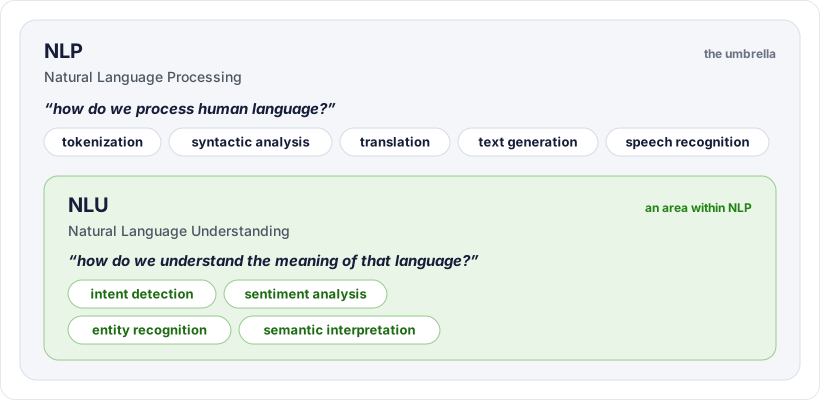
In other words: NLP is the umbrella; NLU is an area within it aimed at understanding what the user meant, what the intent is, which entities appear and what the context of the message is.
A simple distinction
The most practical way to separate the terms is this:
- NLP answers: “how do we process human language?”
- NLU answers: “how do we understand the meaning of that language?”
Another way to look at it:
- NLP includes tasks such as tokenization, syntactic analysis, translation, text generation and speech recognition.
- NLU includes tasks such as intent detection, sentiment analysis, entity recognition and semantic interpretation.
How does it work?
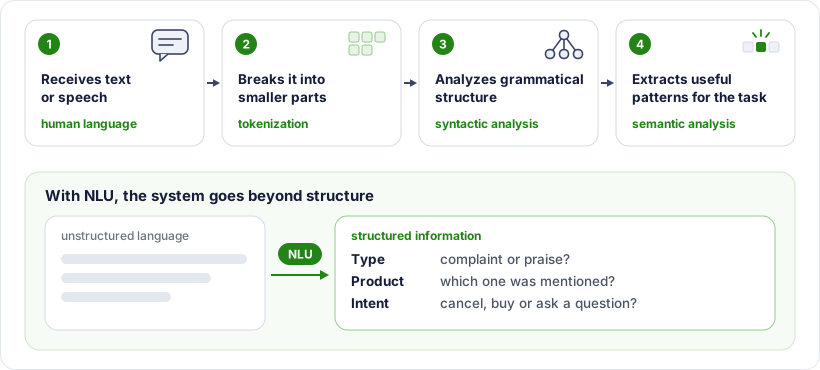
Put simply, NLP systems usually follow a flow: they receive text or speech, break it into smaller parts, analyze grammatical structure and extract useful patterns for some task. IBM describes two core analyses in NLP: syntactic analysis, which looks at the structure of the sentence, and semantic analysis, which tries to extract meaning.
When NLU is involved, the system goes beyond structure and tries to answer questions like: “is this sentence a complaint or praise?”, “which product was mentioned?”, “does the customer want to cancel, buy or ask a question?”. This transformation of unstructured language into structured information is one of the core uses of NLU.
What is it for?
NLP serves to enable more natural interaction between humans and software. It is used when you want a system to read texts, understand questions, summarize documents, translate content, classify messages or talk to users.
NLU is for when it is not enough to “read” the text; the system needs to interpret intent and context to make a better decision. This is very common in chatbots, contact centers, ticket triage, email classification and business automation.
Use cases
Some common NLP/NLU use cases are:
- Chatbots and virtual agents, to understand questions and respond more accurately.
- Sentiment analysis, to detect customer opinion, mood or satisfaction.
- Machine translation, to convert text or speech between languages.
- Text classification, such as categorizing tickets, emails, reviews or documents.
- Entity extraction, such as names of people, companies, dates, amounts and places.
- Semantic search and smart FAQs, to find answers even when the question does not literally match the stored text.
Practical examples
Example 1: customer support
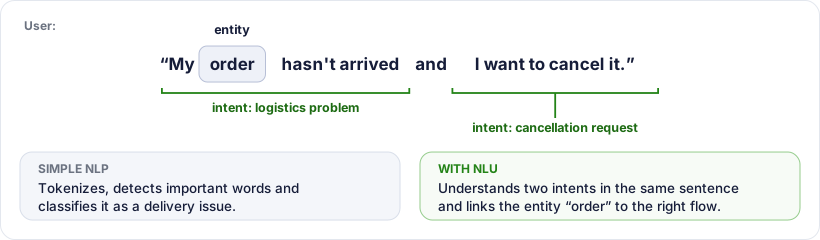
User: “My order hasn’t arrived and I want to cancel it.”
A simple NLP system can tokenize the sentence, detect important words and classify it as a delivery issue. A system with NLU can understand that there are at least two relevant intents there: a logistics problem and a cancellation request.
It can also extract entities such as “order” and link that to the right flow in customer service. This improves routing, automation and the quality of the response.
Example 2: e-commerce
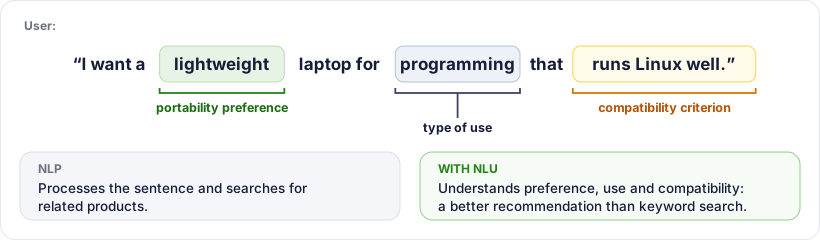
User: “I want a lightweight laptop for programming that runs Linux well.”
NLP helps process the sentence and search for related products. NLU helps understand that “lightweight” is a portability preference, “programming” indicates the type of use and “runs Linux well” is an important compatibility criterion, not just any word.
This allows a better recommendation than a pure keyword search.
Example 3: sentiment analysis
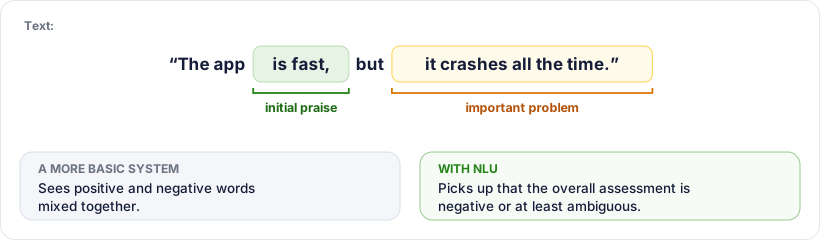
Text: “The app is fast, but it crashes all the time.”
A more basic system may see positive and negative words mixed together. An NLU system tends to better capture that the overall assessment is negative or at least ambiguous, because there is initial praise followed by an important problem.
This kind of task is useful for monitoring user feedback, reviews and support tickets.
Main tasks
These are some classic tasks in the field:
- Tokenization: breaking text into smaller units.
- Parsing / syntactic analysis: understanding grammatical structure.
- Semantic analysis: inferring meaning.
- Intent classification: figuring out what the user wants to do.
- Entity recognition: extracting names, places, dates, amounts, etc.
- Sentiment analysis: detecting positive, negative or neutral opinion.
- Summarization, translation and generation: broader NLP tasks, sometimes with generative models.
Classic NLP versus LLMs
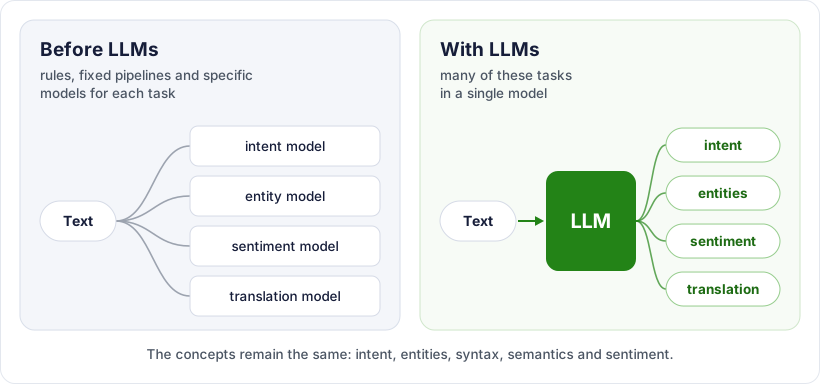
Before LLMs, many NLP systems relied heavily on rules, fixed pipelines and specific models for each task. Today, LLMs can do several of these tasks in a single model, because they were trained at large scale and generalize natural language better.
Even so, the old concepts remain important. When someone talks about intent, entities, syntax, semantics and sentiment, they are talking about the conceptual core of NLP/NLU — only now it is often implemented with LLMs instead of several separate models.
Limits and challenges
Human language is ambiguous, contextual and full of exceptions. That is why NLP/NLU still gets things wrong with irony, double meanings, implicit context, regional expressions, poorly written sentences and very specific domains.
Another important point is that understanding text is not the same as guaranteeing factual truth. A system can understand the question correctly and still answer something wrong if the knowledge base it uses is poor or if the model hallucinates.
A good rule of thumb
If you want to keep a simple rule:
- NLP = everything that involves processing human language.
- NLU = the part that tries to understand meaning and intent.
- NLG = the part that generates language.